 Snow Rider 3D Game
Snow Rider 3D
Snow Rider 3D Gets Harder the Longer You Stay on the Mountain
Snow Rider 3D is built around a simple downhill challenge: keep the sled moving, avoid collisions, collect gifts when the route allows it, and survive for as long as possible.
The mountain constantly carries the sled forward, so there is no comfortable moment to stop and inspect what is coming next. Trees, rocks, snowmen, gaps, uneven terrain, and other obstacles continually force route changes, while gift boxes create additional decisions about whether a reward is worth leaving a safer line.
The difficulty increases naturally as the run continues. Higher speed reduces the amount of time available to identify an obstacle, select a route, steer into position, and recover afterward. The objects themselves do not necessarily need to become more complicated; familiar hazards become harder simply because every decision must be made earlier.
The Mountain Forces You to Make Decisions While Already Moving
Snow Rider 3D does not give you time to stop before a difficult section. The sled continues descending regardless of how crowded the route becomes, which turns forward planning into one of the most important skills.
Reacting only to the obstacle directly in front of the sled works during easier moments, but it becomes increasingly unreliable at higher speed. A safer approach is to look farther down the mountain and identify clusters of hazards before they become immediate threats.
A single tree is easy to understand. A tree followed by a rock, a narrow opening, and another obstacle is a routing problem. Recognizing the whole sequence early allows the sled to move gradually toward a safer line instead of relying on a violent last-second correction.
Look for the Route Beyond the Current Obstacle
Clearing one object is only useful if the resulting position remains safe.
Moving left around a tree may solve the immediate problem but leave the sled directly in front of a rock farther down the same side. A slightly wider route to the right may require more movement at first but create much more usable space afterward.
Longer runs therefore depend on reading what comes after the current obstacle instead of treating every hazard as a separate event.
Small Steering Corrections Preserve More Control
Large steering movements can avoid one danger while creating another. Moving aggressively across the slope may clear a nearby rock but leave the sled badly positioned for the next tree, gap, or narrow passage.
Controlled adjustments are usually more reliable. Move far enough to create clearance, then stabilize instead of continuing the turn longer than necessary.
A useful steering rhythm is:
move → clear → stabilize.
The final step matters because many crashes happen after the original obstacle has already been avoided. Excessive steering can carry the sled directly into a second hazard that would otherwise have been easy to miss.
Central Space Gives You More Options
The middle area of the slope is valuable because it leaves room to move in either direction.
Near one edge, emergency movement becomes limited because most corrections must go back toward the center. A more central position preserves multiple escape routes and makes upcoming obstacle combinations easier to handle.
This does not mean the sled should remain perfectly centered throughout the entire run. Obstacles and gifts constantly change the best route. The important idea is to return toward flexible open space whenever there is no strong reason to remain near an edge.
Trees, Rocks, and Snowmen Create Different Types of Pressure
The main obstacles are easy to recognize individually, but their placement determines how dangerous they become.
Trees Block Large Sections of the Route
Trees occupy significant space and become particularly dangerous when a correction is delayed until the sled is already close.
The safest response is usually to identify the available gap early, move toward it gradually, and begin reading the terrain beyond the tree before actually passing it.
Rocks Are Easy to Notice Too Late
Rocks can occupy less visual space than large trees, which makes them easier to overlook among the snow and surrounding scenery.
At higher speed, a small obstacle does not need to be mechanically complex to end a run. Failing to notice it early is enough.
Snowmen Still Function as Collision Hazards
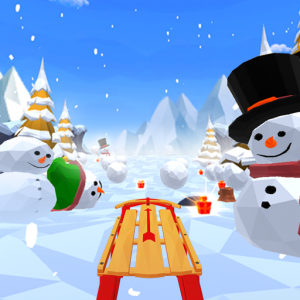
The winter presentation gives Snow Rider 3D a cheerful appearance, but decorative-looking objects can still occupy valuable route space.
A snowman creates the same essential questions as any other hazard: should it be avoided by steering, can it be jumped safely, and what is positioned beyond it?
Jumping Is a Routing Decision, Not an Emergency Button
Jumping can help clear low obstacles, gaps, or dangerous terrain changes, but it should not replace careful steering.
Once the sled leaves the ground, the number of available corrections becomes more limited. A successful jump therefore depends on more than simply clearing the object at takeoff.
The entire maneuver has three important stages:
- Recognize the obstacle or gap early.
- Align the sled before leaving the snow.
- Choose a safe landing path before takeoff.
Takeoff Timing Matters
Jumping too late can cause a direct collision, but jumping too early creates a different problem. The sled may begin descending before the dangerous section has actually been cleared.
Good jump timing comes from judging distance rather than pressing jump immediately whenever something looks threatening.
The Landing Is Part of the Jump
Clearing an obstacle does not complete the maneuver if the sled lands directly in front of another hazard.
While airborne, attention should already shift toward the landing zone and the route beyond it. At higher speeds, there may be almost no recovery time between landing and the next steering decision.
A crash after a jump can therefore begin before takeoff if the chosen line never provided a safe landing path.
Gifts Change the Risk-and-Reward Balance
Gift boxes add another objective beyond simply traveling farther. They provide progression and create reasons to leave the safest possible route.
Not every gift presents the same level of risk. A box sitting naturally along the current line may require almost no additional movement. Another positioned near a tree, gap, or far side of the slope can force a much more dangerous maneuver.
The important skill is deciding whether the reward fits the current route.
Not Every Gift Is Worth Chasing
Treating every visible gift as mandatory can turn optional rewards into unnecessary hazards.
Before committing toward one, consider how much steering is required, what obstacles surround it, how much recovery space remains afterward, and what lies farther down the slope.
If the pickup forces the sled into a significantly worse position, skipping it can produce a stronger run.
Selective Gift Collection Can Produce More Rewards Over Time
One difficult gift may provide immediate progress, but surviving longer creates opportunities to encounter many more.
This makes selective aggression more effective than blindly chasing every box. Easy gifts can be taken confidently, while difficult pickups make more sense only when the surrounding terrain leaves enough room to recover.
Collected Gifts Unlock New Sled Designs
Gift collection also supports progression outside the immediate survival challenge. Collected presents can be used to unlock alternative sled designs. :contentReference[oaicite:3]{index=3}
These unlocks give repeated attempts an additional purpose without replacing the core skill requirement. A new sled does not remove the need to steer accurately, judge jumps, read obstacle sequences, or survive increasing speed.
The progression system therefore adds collection goals while keeping player control at the center of the experience.
Speed Is the Real Difficulty Curve
Snow Rider 3D does not need to completely redesign its obstacles to make a long run difficult. Increasing speed changes how much time is available to respond to the same familiar objects.
At lower speed, a tree visible in the distance leaves plenty of time to choose a side. Later in the run, that same amount of physical distance may provide only a short decision window.
The obstacle has not changed. The amount of thinking time has.
High-Speed Survival Depends on Earlier Decisions
The solution to higher speed is not simply pressing controls faster.
Attention needs to move farther down the slope. Gaps must be identified sooner, steering needs to begin earlier, and jumps need to be prepared before the obstacle becomes urgent.
The sled can become faster while the decision-making becomes calmer. Earlier recognition allows smaller and more deliberate movements.
Panic Steering Becomes More Dangerous at Higher Speed
A long steering input covers much more ground when the sled is moving quickly. A correction that feels harmless early in a run can later send the sled across a large portion of the route before there is time to reconsider.
This makes precision increasingly valuable. Short corrections preserve control, while panic swerves often replace one danger with another.
Narrow Gaps Reward Early Alignment
Two nearby obstacles can form a narrow gate that leaves little room for last-second correction.
Approaching such a gap at an angle makes the final movement harder. A more reliable method is to identify the center of the opening while it is still distant, align gradually, and reduce unnecessary steering as the sled enters.
The less movement required inside the narrow space, the lower the chance of clipping either side.
Aim for Open Snow, Not the Hazard
Obstacle awareness is necessary, but the sled ultimately needs to be guided toward safe space.
Focusing on the clear gap beside a tree can make route selection more natural than staring only at the obstacle itself.
Open snow is valuable because it provides room to stabilize, preserves multiple steering options, and gives more time to read the next sequence.
Distance, Survival, and Score Are Closely Connected
Continuing farther down the mountain forms the foundation of a strong score. Longer survival creates more opportunities to encounter gifts, perform jumps, and accumulate additional progress. :contentReference[oaicite:4]{index=4}
This makes the scoring logic relatively straightforward:
survive first, optimize second.
A risky maneuver may occasionally provide a short-term benefit, but ending the run early removes all future opportunities. In many situations, the safest route and the strongest scoring route are closely aligned.
Snow Rider 3D Does Not Use Traditional Numbered Levels
The game is structured around an endless downhill loop rather than a campaign of numbered stages. :contentReference[oaicite:5]{index=5}
Progress therefore comes from improving reusable skills instead of memorizing a fixed Level 1, Level 2, or Level 3.
- Reading gaps earlier
- Making smaller steering corrections
- Timing jumps more accurately
- Choosing safer gift opportunities
- Planning landing positions
- Handling increasing speed
These skills remain useful even when the exact obstacle sequence changes.
Better Runs Come From Reading Patterns Instead of Individual Objects
A beginner naturally reacts to one obstacle at a time. A tree appears, the sled moves around it, then attention shifts to the next rock or snowman.
As control improves, the mountain begins to look less like a collection of isolated objects and more like a series of possible lines.
A useful route may curve left around one hazard, straighten through an open area, move gradually right, and then prepare for a jump. Thinking in complete routes creates smoother movement and reduces desperate corrections.
Strong Runs Plan Beyond the Current Line
At higher speed, planning one route is not enough. While following the current safe line, attention should already be searching for the next one.
This creates a repeating decision loop:
read → align → pass → stabilize → read again.
The more automatic this process becomes, the farther the sled can travel.
A Practical Strategy for Longer Snow Rider 3D Runs
- Stay near flexible central space when the terrain allows it.
- Scan farther down the slope instead of watching only the sled.
- Identify the largest safe opening.
- Move toward it with controlled steering corrections.
- Collect gifts only when they fit the route.
- Prepare jumps before reaching the obstacle.
- Read the landing zone while airborne.
- Stabilize after each maneuver.
- Repeat the process as speed increases.
The individual actions are simple. Performing them consistently while the reaction window keeps shrinking is the real challenge.
Different Crashes Point to Different Mistakes
Failed runs are useful because the cause of a crash often reveals what needs to change on the next attempt.
If an Obstacle Appeared Too Late
The problem may be visual attention rather than steering speed. Looking farther ahead creates more time to choose a route before the obstacle becomes urgent.
If You Cleared One Hazard and Hit Another
Oversteering may be the issue. Reduce the duration of the directional input instead of trying to move even faster.
If a Gift Pulled You Into a Bad Route
The mistake may be risk selection rather than mechanical control. Some gifts simply do not justify the route required to collect them.
If You Crashed Immediately After a Jump
The landing path may have been wrong before takeoff. Future attempts should focus on choosing a better line through the entire jump rather than only improving the moment of leaving the ground.
Gift Hunting and High-Score Runs Can Require Different Priorities
Some attempts can focus more heavily on collecting gifts, while others can prioritize maximum distance and score.
The objectives overlap because better survival creates more collection opportunities, but they are not identical.
If unlocking another sled is the immediate goal, taking a moderate gift risk may make sense. If the objective is a longer distance record, skipping difficult pickups becomes easier to justify.
Knowing the purpose of the current run can improve decision-making before a risky maneuver begins.
Snow Rider 3D Rewards Calm Control More Than Constant Movement
The game looks fast, but effective control is often restrained.
Constant left-right movement uses valuable space and makes future corrections harder to judge. The strongest routes are usually built from small movements separated by moments of stability.
Move because the terrain requires it, not simply because the sled can move.
As the speed rises, concentration also becomes increasingly important. One careless second after dozens of successful decisions can still end the entire attempt.
The Core Challenge Never Changes—Only the Pressure Does
Snow Rider 3D keeps its basic rules understandable throughout a run. You steer, jump, avoid obstacles, evaluate gifts, and try to remain alive.
What changes is the amount of time available to perform those actions.
Higher speed turns familiar mechanics into harder decisions, and longer survival depends less on frantic reactions than on seeing the mountain earlier, choosing cleaner routes, using smaller steering inputs, and preserving enough open space for the next move.
That is what gives the game its depth. The controls remain simple, but every extra meter demands increasingly accurate judgment.


Discussion about: Snow Rider 3D
0